

Avoiding Dehydrated Onion & Garlic Issues
Key Takeaway
Common dehydrated onion and garlic problems such as caking, color variation, inconsistent mesh, high moisture and off-odor can result from inadequate drying, storage or packaging. Buyers can reduce these risks by defining measurable specifications, approving samples and confirming process and packaging controls before bulk production.
Most quality complaints on dehydrated onion and garlic shipments trace back to a handful of recurring failure modes: caking, color variation, inconsistent mesh, high moisture and off-odor. For export procurement, specifications should define measurable limits such as moisture ≤6.0%, particle size or mesh, acceptable appearance, packaging requirements and storage conditions.
These issues can affect production efficiency, rehydration performance, finished-product appearance and shelf stability. A product that meets the agreed specification at dispatch can still deteriorate if packaging is unsuitable or the cargo is exposed to unfavorable storage and transit conditions.
For procurement teams, the objective should therefore be more than selecting the lowest quoted price. Supplier evaluation should include drying controls, product inspection, packaging construction, storage practices, sampling procedures and the supplier’s ability to maintain the same specification across repeat lots.
Common Quality Problems and Their Root Causes
| Quality Problem | Typical Risk | Possible Root Cause | Buyer Control |
|---|---|---|---|
| Caking / Clumping | Product becomes difficult to discharge, dose or process | Excess moisture, inadequate drying, moisture ingress during storage | Define moisture limit and moisture-resistant packaging |
| Color Variation | Inconsistent appearance in finished foods | Raw-material variation, drying conditions, storage or oxidation | Approve reference sample and define appearance requirements |
| Inconsistent Mesh | Uneven dosing, processing or finished texture | Poor size reduction or inadequate screening | Specify particle size, mesh range and tolerance |
| High Moisture | Reduced shelf stability and increased quality risk | Incomplete drying or moisture ingress | Set maximum moisture and require batch testing |
| Off-Odor | Unacceptable aroma or flavor contribution | Poor storage, moisture exposure, contamination or prolonged transit | Define odor requirements and verify packaging and storage controls |
Caking is frequently associated with moisture. Dehydrated products are hygroscopic, so exposure to humid conditions can cause particles to absorb moisture and adhere to one another. Proper drying must therefore be supported by packaging that limits moisture ingress during storage and transport.
Color variation can originate from differences in raw material as well as processing and storage conditions. For buyers using dehydrated onion or garlic in standardized food formulations, a visual reference sample and clearly defined acceptance criteria can reduce disputes between lots.
Inconsistent mesh is primarily a specification and screening issue. If a buyer requires a particular particle-size distribution, the purchase specification should identify the required cut or mesh rather than using broad terms such as “fine,” “medium” or “standard.”
Turning Defect Risks Into Measurable Acceptance Criteria
A strong purchase specification converts subjective quality expectations into measurable parameters that a QA team can inspect against, rather than relying on visual judgment alone at receipt.
| Quality Parameter | Acceptance Criterion | How Buyers Verify It |
|---|---|---|
| Moisture | ≤6.0% for standard cuts; tighter limits (e.g. ≤5.0%) for powder | Batch moisture test certificate + incoming re-test |
| Appearance / Color | Matches approved reference sample | Side-by-side visual comparison against retained sample |
| Particle Size / Mesh | Within agreed cut form or mesh range and tolerance | Sieve analysis against the required distribution |
| Odor | No off-odor; matches defined sensory profile | Sensory check on receipt, before bulk release |
| Packaging Integrity | Correct net weight, intact moisture barrier, no ingress | Physical inspection of bags/liners at unloading |
(For the specific cut-size and mesh-range definitions — flakes, chopped, minced, granules and powder — see our mesh size guide.)
Moisture should be treated as the highest-priority procurement parameter because it drives caking risk directly: dehydrated onion and garlic are hygroscopic, so any gap between the agreed limit and the tested value is an early warning sign rather than a minor deviation.
Appearance and odor criteria are only enforceable when they are anchored to a physical reference. A specification that says “good color, no off-odor” without an approved sample or defined threshold leaves both sides guessing at the acceptance point.
Packaging, Storage and Transit Controls
Even correctly dried dehydrated onion or garlic can develop quality problems if it is exposed to moisture after processing. Packaging should therefore be selected according to the product, destination, expected storage period and transportation conditions.
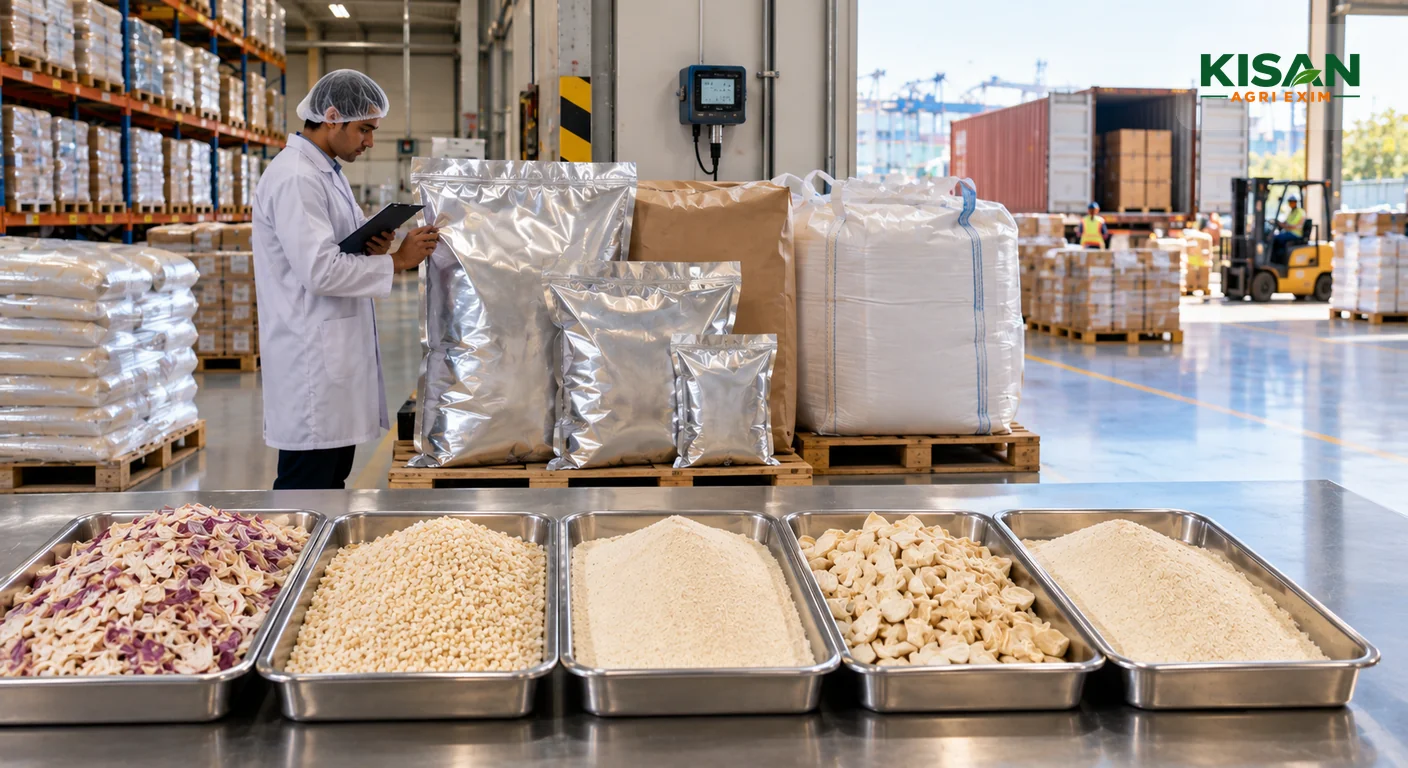
Bulk export packaging should provide an appropriate barrier against moisture and contamination while maintaining product integrity during handling and container transport. The packaging specification should identify the bag construction, net weight, inner liner requirements where applicable, closure method and palletization or loading requirements.
Storage conditions are equally important. Products should be kept in a clean, dry environment away from direct moisture and contamination. Poor warehouse conditions can gradually increase moisture levels and contribute to caking or odor changes.
Long transit periods can increase the importance of packaging performance. Buyers should discuss the expected shipping route, transit duration and destination storage conditions with the supplier before finalizing the packaging specification.
How Buyers Can Write Specifications That Prevent Problems
A purchase specification should be specific enough for the supplier’s production and quality teams to manufacture and inspect against the same requirements.
At minimum, the specification should cover:
- Product name and dehydrated form
- Cut size or mesh range
- Maximum moisture percentage
- Appearance and acceptable color characteristics
- Odor requirements
- Packaging material and net weight
- Required inner liner or moisture barrier
- Microbiological requirements where applicable
- Sampling and approval requirements
- Labelling and batch identification requirements
- Shipping and storage requirements
For example, instead of requesting “good quality dehydrated onion granules,” a buyer can specify a defined granule range, maximum moisture, appearance requirements, packaging configuration and applicable microbiological limits. This reduces interpretation differences between buyer and supplier.
The approved sample should also be retained as a reference for repeat orders. When the commercial specification and physical reference sample are aligned, subsequent lots can be evaluated against the same quality expectation.
Questions Buyers Should Ask Suppliers Before Ordering
Before placing a bulk order, procurement and QA teams should ask the supplier how the product is dried, screened, tested, packed and stored.
How is moisture controlled?
Ask what maximum moisture level is targeted, how moisture is measured and whether finished batches are tested before dispatch. The agreed moisture limit should appear in the purchase specification rather than remaining a verbal expectation.
How is particle size controlled?
Ask whether the product is screened after size reduction and how the supplier verifies the requested mesh or cut size. For applications sensitive to particle distribution, buyers should also clarify the acceptable tolerance.
How is color consistency maintained?
Ask whether the supplier uses an approved reference sample or defined appearance criteria for repeat production. This is particularly important when dehydrated onion or garlic is visible in the final food product.
What packaging is used for export shipments?
Ask for the packaging construction, liner or barrier details, net weight and suitability for the intended transit and storage period. Packaging should be evaluated as part of the product specification rather than treated as a separate logistics decision.
How are lots identified and inspected?
Ask whether batches are traceable through production and quality-control records and what checks are completed before dispatch. Clear lot identification helps buyers investigate any quality variation after receipt.
How Kisan Agri Exim Designs Processes to Avoid These Issues
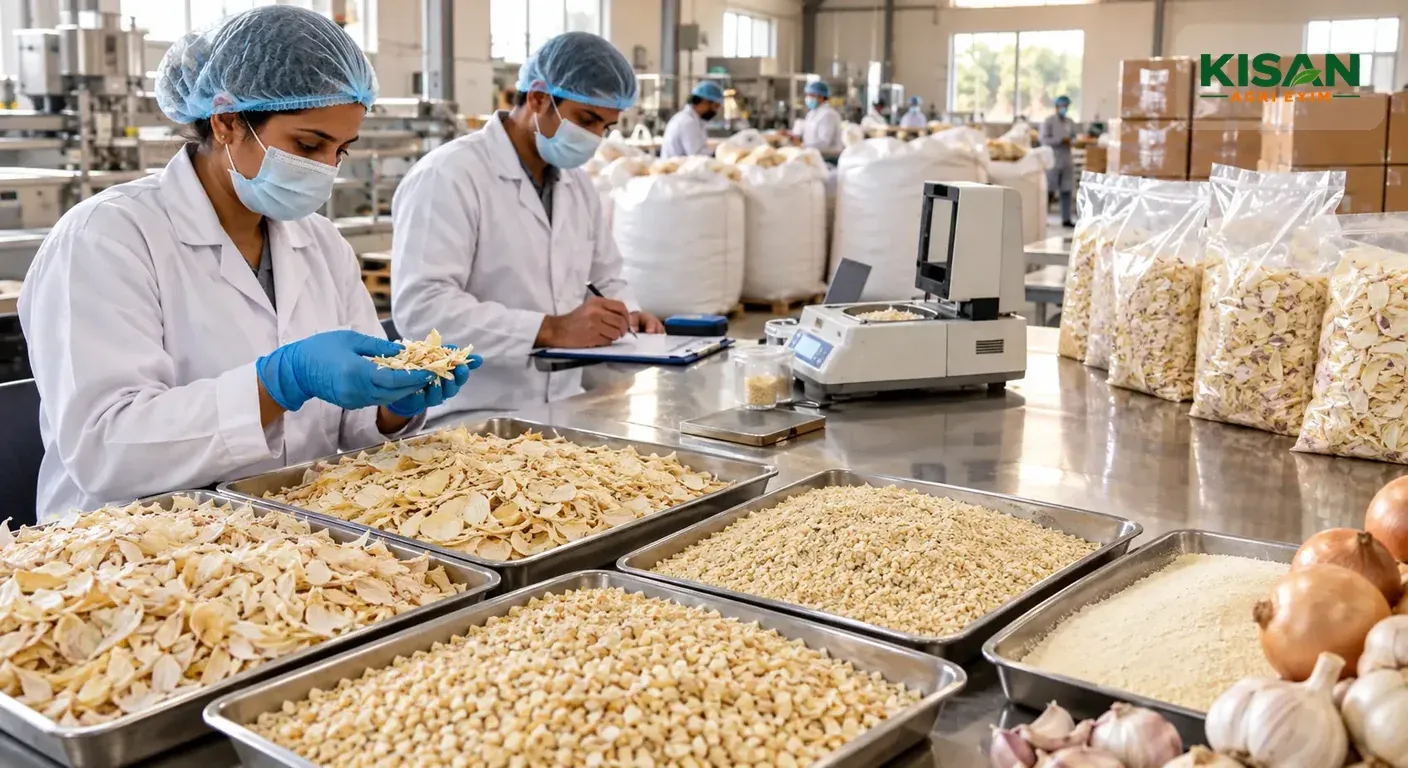
Kisan Agri Exim approaches dehydrated onion and garlic supply by aligning product specifications with processing, screening, quality inspection and export packaging requirements. The objective is to maintain the agreed product characteristics from production through shipment rather than relying only on final visual inspection.
Product specifications can be defined around measurable parameters such as cut size or mesh, maximum moisture, appearance and packaging configuration. Samples can then be evaluated against these requirements before the buyer proceeds with regular supply.
Process controls also need to address the stages where quality can change. Drying affects moisture and product stability, screening affects particle-size consistency, inspection helps identify visual variation, and suitable packaging reduces the risk of moisture exposure during storage and transit.
For export orders, the packaging and loading plan should also consider the destination, expected transit conditions and required shipment quantity. This process-based approach helps reduce avoidable quality variation and gives procurement teams clearer checkpoints before accepting repeat lots.
Quality Control Checklist for Buyers
Before approving a dehydrated onion or garlic shipment, buyers can use the following checklist:
- Confirm the product form and cut size or mesh.
- Verify moisture against the agreed maximum.
- Compare color and appearance with the approved reference sample.
- Check particle-size consistency and excessive fines where relevant.
- Confirm the product has no unacceptable off-odor.
- Verify packaging integrity and correct net weight.
- Confirm batch identification and traceability information.
- Review applicable microbiological test requirements.
- Check that shipment packaging is appropriate for the planned transit and storage period.
Using the same checklist for samples, pilot quantities and regular shipments creates a consistent quality-control process across the procurement cycle.
Conclusion
Most quality problems in dehydrated onion and garlic can be reduced by controlling the full supply chain from drying and screening through packaging, storage and transit. Buyers should define measurable specifications, approve representative samples and evaluate supplier process controls rather than relying only on product price or appearance.
Next Step
See QA parameters and product specifications in our dehydrated onion range or dehydrated garlic range, or talk to our export sales desk to receive physical reference samples and a custom bulk quote for your procurement team.
FAQs
What causes dehydrated onion and garlic to cake?
Caking is commonly associated with moisture absorption after drying. Inadequate drying, moisture ingress through packaging or humid storage conditions can cause particles to absorb moisture and form clumps.
What moisture level should buyers specify for dehydrated onion and garlic?
The template specification uses a maximum moisture level of ≤6.0% for common dehydrated cuts, while powder is specified at ≤5.0%. The final purchase specification should be agreed according to the product form and application.
How can buyers prevent inconsistent mesh in dehydrated onion and garlic?
Specify the required cut size or mesh range and an acceptable tolerance before production. The supplier should use appropriate size reduction and screening controls and verify the finished batch against the agreed specification.
Can packaging affect the quality of dehydrated onion and garlic during transit?
Yes. Moisture ingress during storage or long-distance transit can contribute to caking and quality deterioration. Packaging should therefore be selected according to the product, shipping route, transit duration and destination storage conditions.
What should buyers check before placing a bulk order?
Buyers should confirm product form, mesh or particle size, maximum moisture, appearance, odor, packaging, applicable microbiological requirements, sampling procedures and batch traceability before approving regular supply.
Ready to source?
Looking for a reliable export partner?
Our export team responds within 24 hours to help you with your bulk sourcing and custom quotation requirements.