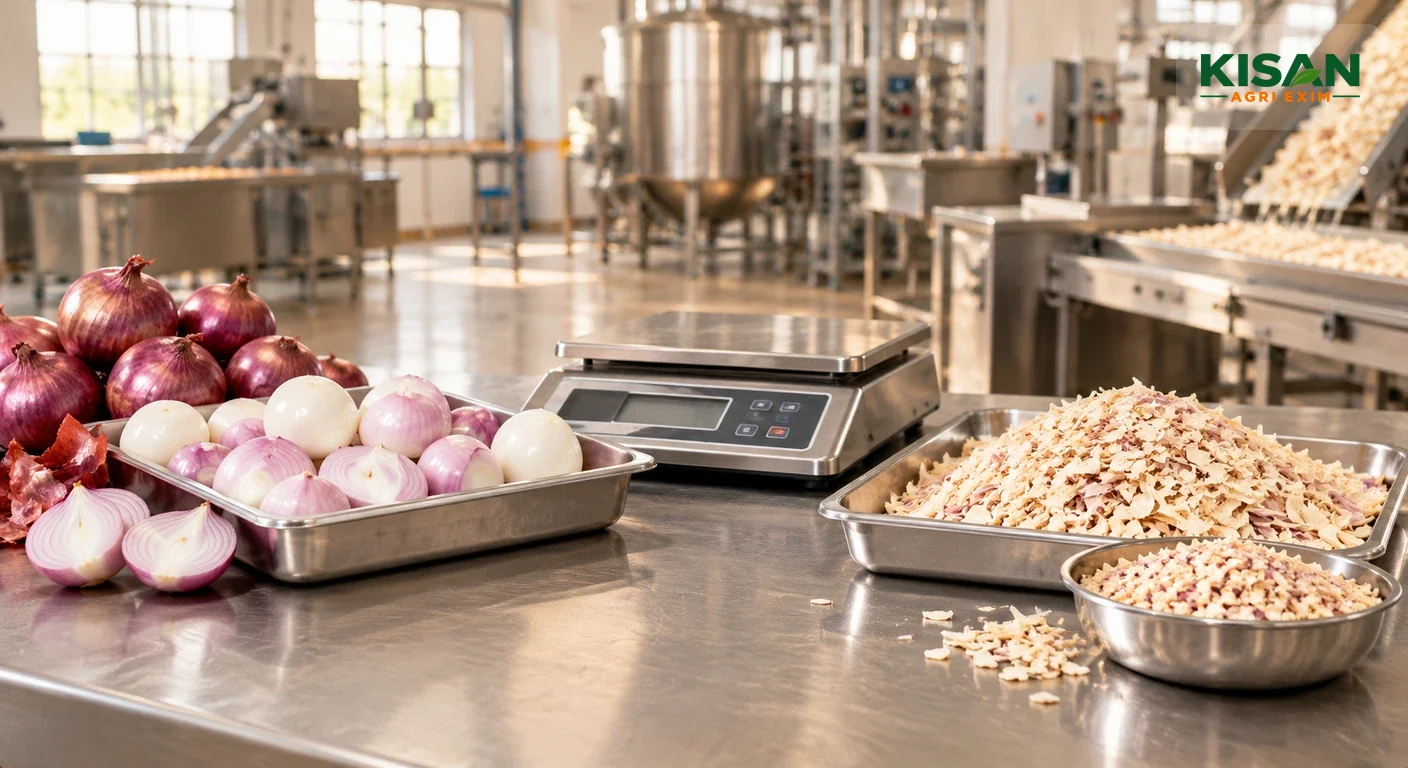


Dehydrated Onion & Garlic Mesh Size Guide
Key Takeaway
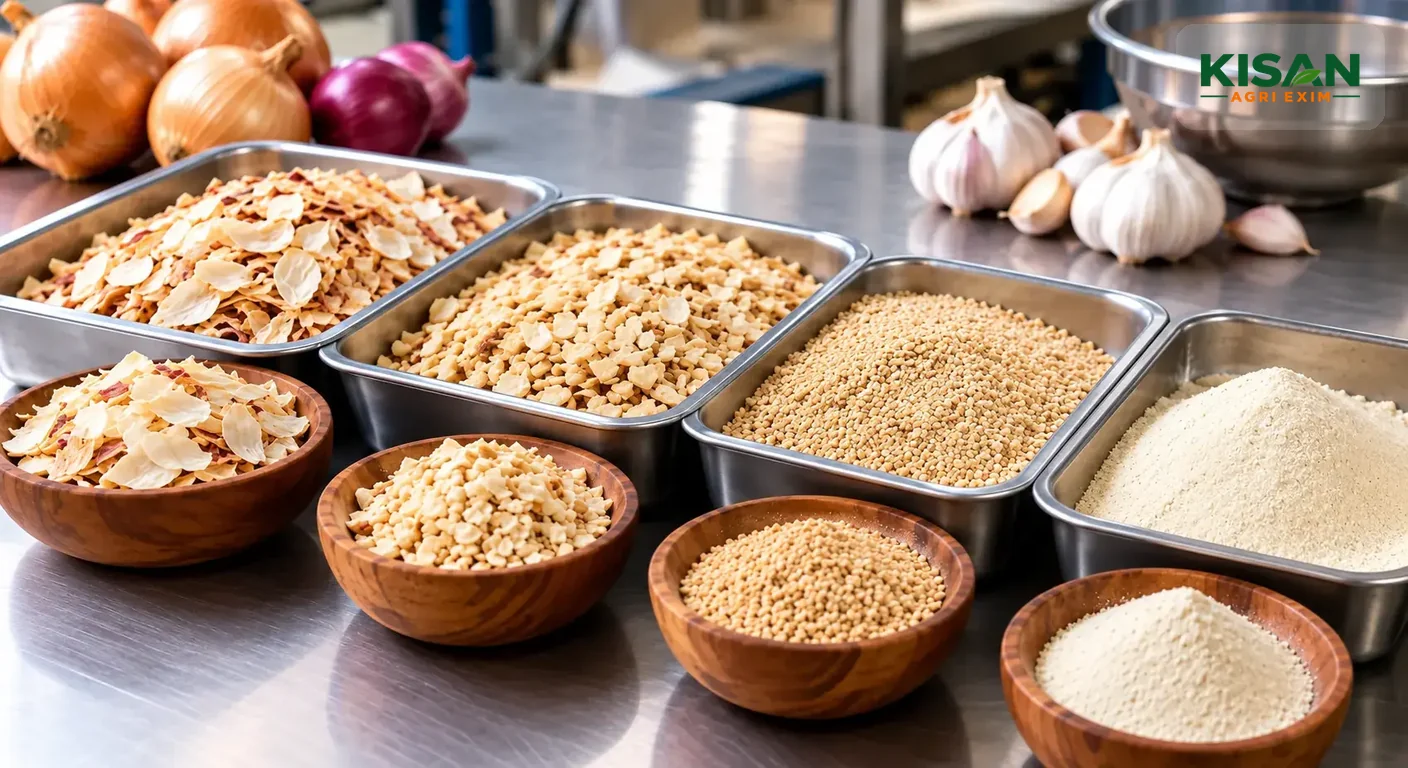
Selecting the correct mesh size depends on required rehydration speed and recipe texture. Flakes (8-25mm) suit soups and prepared meals, granules (40-80 mesh) work best in dry seasonings, while fine powder (80-120 mesh) provides instant flavor dissolution in sauces and snacks.
Understanding Particle Cut Forms in Industrial Processing
The correct dehydrated onion or garlic particle size is determined primarily by the required rehydration rate, texture, visual profile, and dispersion in the finished product. For industrial procurement, flakes/kibbled, chopped, minced, granules, and powder are not interchangeable specifications because each behaves differently during processing.
1. Flakes / Kibbled — 8–25 mm
Flakes and kibbled products are the largest common cut forms, generally supplied in the 8–25 mm range.
- Particle size: 8–25 mm
- Typical use: Soups, prepared meals, sauces with visible vegetable pieces, stuffing mixes, instant meal formulations
- Rehydration: Slowest among the listed forms because of the relatively low surface-area-to-volume ratio
- Appearance: High visual impact; retains identifiable onion or garlic pieces after rehydration
- Processing consideration: Requires sufficient hydration time and liquid availability
This form is generally selected when the finished food must retain a visible onion or garlic component rather than simply deliver flavor.
2. Chopped — 3–5 mm
Chopped dehydrated onion and garlic provide a smaller particle than flakes while retaining visible structure.
- Particle size: 3–5 mm
- Typical use: Canned sauces, ready meals, seasoning blends, stuffing mixes, dry meat preparations
- Rehydration: Faster than flakes
- Appearance: Visible but more evenly distributed particles
- Processing consideration: Suitable when manufacturers need both texture and relatively uniform dispersion
The 3–5 mm range is useful when a formulation requires identifiable onion or garlic without the larger pieces associated with kibbled products.
3. Minced — 1–3 mm
Minced products sit between chopped material and fine granules.
- Particle size: 1–3 mm
- Typical use: Dry meat rubs, sauces, gravies, instant foods, seasoning blends
- Rehydration: Relatively fast because of increased exposed surface area
- Appearance: Small visible particles
- Processing consideration: Provides stronger distribution through a formulation than larger cuts
Minced onion or garlic is often appropriate when a product requires some particulate character but cannot accommodate large flakes.
4. Granules — 0.2–1.0 mm / 40–80 mesh
Granules are designed for controlled dispersion in dry formulations and seasoning systems.
- Particle size: Approximately 0.2–1.0 mm
- Common specification: 40–80 mesh, depending on the requested sieve distribution
- Typical use: Snack seasonings, instant noodle seasoning, spice blends, dry rubs, soups and convenience-food mixes
- Rehydration: Fast
- Appearance: Low visual particle prominence compared with minced or chopped products
- Processing consideration: Good balance between handling, dispersion and flavor release
Mesh terminology requires attention during procurement. Mesh count describes the number of openings per linear inch of a sieve, while particle size is expressed in mm. The relationship is not a perfect one-to-one conversion because actual particle passage also depends on sieve construction, particle shape and the applicable standard. Therefore, OEM buyers should specify both the target mesh distribution and acceptable particle-size range.
5. Powder — 80–120 mesh
Powder is the finest form in this guide and is intended for rapid dispersion and flavor delivery.
- Particle specification: 80–120 mesh
- Typical use: Snack seasonings, sauces, instant mixes, soup bases, spice blends and seasoning sachets
- Rehydration/dissolution: Fastest of the listed forms
- Appearance: Minimal visible particulate structure
- Processing consideration: Requires greater control of moisture, caking and storage conditions
Fine powder has a high surface-area-to-mass ratio. This enables rapid contact with water or oil-based food systems but also makes the material more sensitive to moisture pickup and agglomeration during storage.
Particle Size vs. Application Matrix
The following matrix provides a practical starting point for industrial product selection. Actual specifications should be confirmed against the buyer’s recipe, processing conditions, sieve method and destination-market requirements.
| Cut Form | Particle Size / Mesh | Moisture % | Key Food Application |
|---|---|---|---|
| Flakes / Kibbled | 8–25 mm | ≤6% | Prepared meals, soups, visible-ingredient mixes |
| Chopped | 3–5 mm | ≤6% | Canned sauces, ready meals, stuffing and food-service mixes |
| Minced | 1–3 mm | ≤6% | Dry meat rubs, gravies, sauces and seasoning blends |
| Granules | 0.2–1.0 mm / 40–80 mesh | ≤6% | Snack seasonings, instant soups, dry blends and noodle seasoning sachets |
| Powder | 80–120 mesh | ≤6% | Fine snack seasonings, instant mixes, sauces and soup bases |
For export procurement, moisture ≤6% is a useful specification target for maintaining product stability, but moisture should not be evaluated in isolation. Buyers should also define microbiological requirements, foreign-matter limits, colour, flavour profile, packaging conditions and applicable food-safety specifications.
Where microbiological limits are part of an OEM specification, requirements such as total plate count in CFU/g, yeast and mould, coliforms and pathogen absence should be agreed before production rather than assumed from the particle-size specification.
How Particle Sizing Affects Flavor Release and Rehydration
Particle size changes the physical behaviour of dehydrated onion and garlic during mixing, cooking and rehydration.
Surface-Area-to-Volume Ratio
As particle size decreases, the exposed surface area relative to particle volume increases.
A simplified comparison is: Flakes → Chopped → Minced → Granules → Powder
Moving toward smaller particles generally increases contact between the dehydrated material and the surrounding water, oil or food matrix. This accelerates moisture transfer and makes flavour compounds available more quickly. This does not mean that smaller particles always produce a better product. The correct choice depends on the desired sensory profile.
Rehydration Kinetics
Larger particles require more time for water to penetrate the structure and restore moisture throughout the particle.
- 8–25 mm flakes: Slower hydration and stronger visible texture
- 3–5 mm chopped: Moderate hydration
- 1–3 mm minced: Faster hydration and wider distribution
- Granules: Rapid hydration and dispersion
- 80–120 mesh powder: Very rapid wetting and distribution
For instant foods, the cooking or hydration cycle should therefore be considered when selecting the cut. A large flake may remain firm when a consumer expects a fully rehydrated ingredient, while an excessively fine powder may disappear into the formulation.
Flavor Burst Timing
Particle size also influences when the consumer perceives onion or garlic flavour. Larger particles can provide a more gradual release as they hydrate and are processed. Smaller particles expose more material to the surrounding food matrix, allowing flavour to become available earlier.
For example:
- Dry meat rubs: Minced or granulated onion/garlic can provide distributed flavour without creating large pieces.
- Snack seasonings: Fine granules or powder can adhere to the product surface and distribute flavour uniformly.
- Instant noodle seasoning: Granules and fine particles disperse rapidly in the hot broth.
- Canned sauces: Minced or chopped cuts can provide both flavour and particulate identity.
- Soup mixes: Flakes can provide visible vegetable texture, while smaller cuts deliver faster flavour dispersion.
Dissolution and Dispersion
Powder should not automatically be treated as equivalent to a fully soluble ingredient. Dehydrated onion and garlic powders are particulate food ingredients; they disperse and hydrate in a formulation rather than behaving exactly like a pure water-soluble chemical.
In dry blends, finer particles can also segregate if particle density, shape and size differ substantially from the other ingredients. Formulators therefore need to evaluate powder flow, blend uniformity and conveying behaviour alongside flavour performance.
Anti-Caking Considerations
Fine onion and garlic particles have greater surface area and can interact more readily with ambient moisture. This increases the importance of:
- Moisture control
- Moisture-barrier packaging
- Appropriate storage humidity
- Controlled handling
- Blend compatibility
- Anti-caking strategy where permitted by the formulation and destination-market regulations
A technically correct mesh specification can still perform poorly if the product absorbs moisture during transport or storage.
Batch Consistency
Particle-size consistency directly affects dosing and distribution in automated manufacturing systems. If one production lot contains excessive fines while another contains oversized particles, the same recipe can produce different hydration rates, flavour distribution and visual appearance.
For this reason, industrial buyers should specify:
- Target particle size in mm.
- Target mesh or sieve distribution.
- Maximum oversize percentage.
- Maximum fines percentage where relevant.
- Moisture limit.
- Microbiological limits.
- Colour and sensory requirements.
- Packaging and storage requirements.
This provides a more reliable purchasing specification than simply ordering “dehydrated onion” or “garlic powder.”
Custom Sieving and Private Label Sourcing at Kisan Agri Exim
Kisan Agri Exim supplies dehydrated onion and garlic products from Mahuva, Gujarat, India, with processing specifications designed for industrial and export requirements.
For OEM and bulk buyers, particle size can be aligned with the intended application through precision sieving and controlled particle sizing rather than relying on a generic grade.
Processing can include:
- Custom sieve selection according to the required particle distribution
- Precision separation of different particle fractions
- Controlled sizing for chopped, minced and granular products
- Fine sieving for powder specifications
- Optical sorting to help remove unwanted colour and foreign-material fractions
- Batch-level quality checks against agreed specifications
- Bulk export packaging configured to customer requirements
- Private-label packaging for approved OEM and distribution programs
For a buyer ordering 40–80 mesh granules, for example, the commercial specification should define the required sieve distribution rather than using “40–80 mesh” as the only quality parameter. This reduces ambiguity between supplier and buyer and makes incoming quality control more repeatable.
Kisan Agri Exim can work with the buyer’s product specification, target application, pack size and destination-market requirements to establish the appropriate processing and packaging configuration before bulk production.
Conclusion
For procurement managers, the practical rule is simple: choose larger cuts when visible texture and slower rehydration are required, and smaller particles when rapid dispersion and early flavour release are the priority. Always specify particle size, mesh distribution, moisture ≤6%, microbiological requirements and packaging conditions together rather than treating mesh size as the complete product specification.
Next Step
See cut forms, particle dimensions, and mesh sizing in our dehydrated onion range or dehydrated garlic range, or talk to our export sales desk to request physical particle samples and custom bulk pricing.
FAQs
What is the difference between onion granules and onion powder?
Onion granules are coarser particles, commonly specified around 40–80 mesh, while onion powder is a finer material typically specified around 80–120 mesh. Granules provide more controlled particulate structure, while powder disperses and hydrates more rapidly.
What mesh size is best for instant noodle seasoning packets?
40–80 mesh granules are a practical choice for instant noodle seasoning because they provide rapid dispersion while maintaining manageable powder flow. Finer 80–120 mesh powder can be used when the formulation requires faster distribution and minimal visible particles.
Can Kisan Agri Exim customize particle sizes according to client specifications?
Yes. Kisan Agri Exim can provide custom sieving and particle sizing for dehydrated onion and garlic according to agreed OEM specifications, including target mesh distribution, moisture limits, packaging format and private-label bulk export requirements.
Ready to source?
Looking for a reliable export partner?
Our export team responds within 24 hours to help you with your bulk sourcing and custom quotation requirements.