

Garlic Types for Dehydration
Key Takeaway
Indian garlic selected for dehydration combines high dry matter with suitable bulb size, clove structure and pungency. Yamuna Safed varieties illustrate the range: G-323 bulbs average 3.5–4.0 cm with 20–25 cloves, while G-189 bulbs measure 4.5–5.0 cm with 22–30 cloves.
Indian Garlic Types for Dehydration
Indian garlic suited to industrial dehydration is selected for dry matter, clove structure, bulb size and pungency. Dehydration varieties generally require 35–40% dry matter, while improved cultivars such as Yamuna Safed 4 (G-323) and Yamuna Safed 5 (G-189) offer distinct bulb and clove profiles. Source Source
India’s commercial garlic is largely made up of short-day tropical types. Traditional local genotypes tend to have smaller bulbs and more cloves per bulb; for processors, that structure can mean more peeling effort and a greater chance of skin remaining with the prepared cloves. Improved varieties are valued for more uniform bulbs and clean white-to-silvery tunics, traits relevant to raw-material sorting and preparation.
Variety is only one part of procurement quality. Physical condition, curing and market grading determine whether incoming bulbs can be handled consistently, while dry matter and pungency influence the character and processing value of the garlic. These factors matter to buyers assessing raw garlic for flakes, granules or powder.
How Garlic Varieties Differ in Bulb and Clove Size
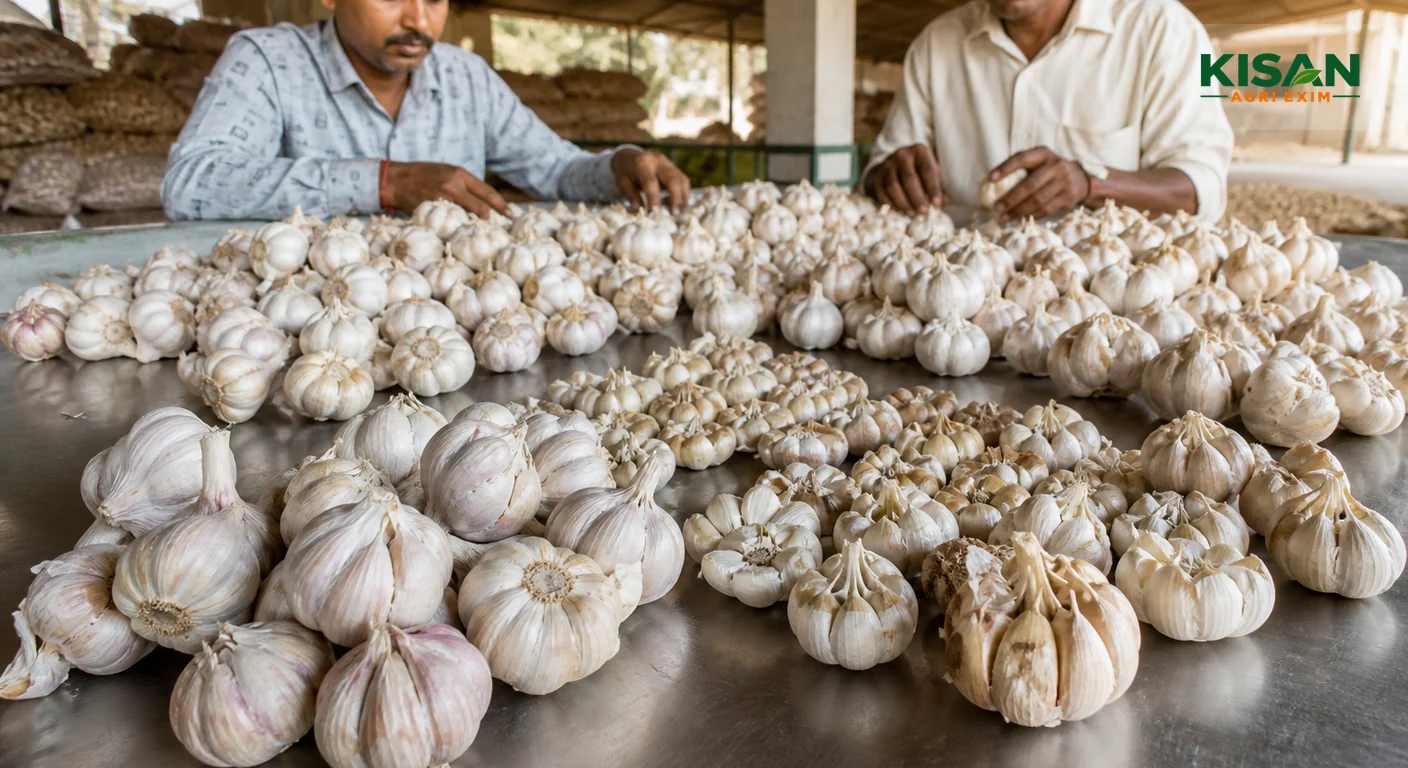
Yamuna Safed 4 (G-323) produces silvery-white bulbs with an average diameter of 3.5–4.0 cm and 20–25 cloves per bulb. Yamuna Safed 5 (G-189) has creamy-white bulbs measuring 4.5–5.0 cm across, with 22–30 cloves per bulb. Source
Yamuna Safed 2 (G-50) is reported with a total soluble solids (TSS) content of 38–40%, along with an equatorial bulb diameter of 3.5–4.5 cm. TSS provides a useful indicator of solids content, but it should not be treated as interchangeable with a direct dry-matter measurement. Source
Larger, more uniform bulbs can be easier to handle in preparation, but bulb diameter alone does not determine suitability. Clove count and size affect peeling and preparation, while dry matter indicates how much solid material remains after water removal. Variety selection is therefore a balance of physical handling traits and composition rather than a simple ranking by bulb size.
Dry Matter, Pungency and Mandi Grading
Dry matter is an important raw-material characteristic for dehydration. Garlic varieties suited to industrial dehydration are associated with 35–40% dry matter; higher solids content supports better finished-product yield from the raw material. Source
Garlic pungency develops when cells are disrupted during cutting or milling. The enzyme alliinase acts on alliin, producing allicin and subsequent sulfur compounds that contribute to garlic’s characteristic aroma and flavour. Pungency is therefore relevant to the sensory profile of dehydrated garlic used in seasonings and spice blends.
At APMC mandis, raw garlic is commonly sorted by visible physical characteristics. Bulbs may be separated into large or extra-large, medium and small categories, with local terms and size cut-offs varying by market. Larger bulbs can command a premium because of their flesh-to-peel ratio, but grading is not uniform across all mandis.
Soundness and cleanliness also affect market grade. Compact, firm, well-cured bulbs are preferred; loose tunics, splits, sprouting, discoloration and insect damage reduce quality. Soil around the basal plate, stones and loose leaf stems are treated as foreign matter and can lead to price deductions or rejection.
After preparation and dehydration, garlic is graded by product form and particle size rather than by the original bulb category. Dehydrated flakes or pieces fall within a 1.25–4 mm sieve-aperture range, while at least 95% of garlic powder must pass through a 250 µm aperture. Source
Conclusion
For procurement managers, QA leads and supply chain directors, garlic variety assessment should connect bulb and clove dimensions with dry matter, pungency and physical soundness. Mandi grades help describe incoming raw material, but local grading varies; finished dehydrated grades are defined by product form and particle size.
Next Step
See specifications and cut forms in our dehydrated onion range or dehydrated garlic range, or talk to our export sales desk to get tailored product specifications and custom bulk pricing for your market.
FAQs
Which Indian garlic varieties are used for dehydration?
Improved Indian varieties include the Yamuna Safed series. G-323 has bulbs averaging 3.5–4.0 cm with 20–25 cloves per bulb, while G-189 bulbs measure 4.5–5.0 cm and contain 22–30 cloves.
What dry matter content is suited to garlic dehydration?
Garlic varieties suited to industrial dehydration require 35–40% dry matter. Yamuna Safed 2 (G-50) is reported with 38–40% TSS, a related measure of soluble solids rather than a direct dry-matter result.
How is garlic graded at Indian mandis?
Mandi grading commonly considers bulb size, firmness, curing, visible damage and foreign matter. Size categories and their cut-offs vary between markets rather than following one uniform classification.
Ready to source?
Looking for a reliable export partner?
Our export team responds within 24 hours to help you with your bulk sourcing and custom quotation requirements.