

From Farm to Factory in Gujarat
Key Takeaway
Kisan Agri Exim connects agricultural sourcing in Gujarat with controlled dehydration and export supply, with farmer selection and raw-material quality forming the first stage of the process. By converting suitable fresh onions into a stable dehydrated ingredient, the supply chain can reduce post-harvest losses while creating a more consistent route to industrial buyers.
From Gujarat Farms to Dehydrated Onion Supply
The quality of dehydrated onion begins before the product reaches the processing facility. Kisan Agri Exim’s farm-to-factory approach connects onion sourcing in Gujarat with raw-material selection, controlled dehydration, quality inspection and export preparation.
For a dehydrated onion manufacturer, the agricultural supply chain is a critical part of product consistency. Fresh onions can vary in size, maturity, moisture and overall quality, so selecting suitable raw material is an important first control point.
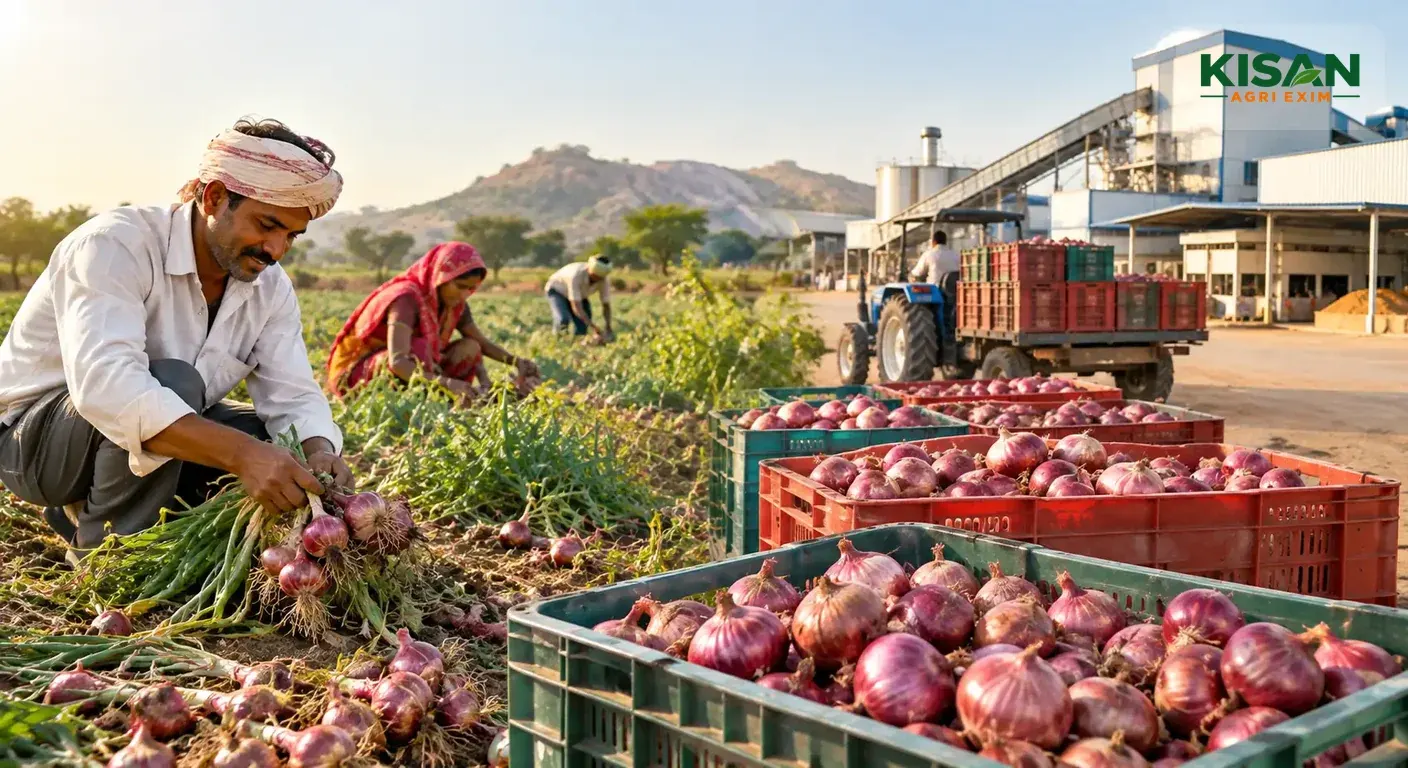
Gujarat, and particularly the Saurashtra region around Mahuva, has an established agricultural base that supports onion sourcing. Building relationships within the local farming ecosystem provides closer access to raw material and helps connect agricultural production with processing requirements.
For international buyers, this origin-level connection is commercially relevant. A reliable dehydrated onion supply depends not only on processing equipment but also on how raw material is sourced, selected and moved from farms to the factory.
Onion Sourcing Around Mahuva and Saurashtra
Mahuva is an important location within the onion-processing ecosystem of Saurashtra. Its agricultural surroundings provide access to onion-producing areas and support the movement of fresh agricultural produce into processing operations.
The farm-to-factory model begins with sourcing from suitable agricultural regions rather than treating raw material as an interchangeable commodity. The objective is to obtain onions that are appropriate for dehydration and capable of producing the required finished-product characteristics.
For processors, proximity between sourcing areas and the processing facility can also be important because fresh agricultural produce requires timely handling. Reducing unnecessary delays between harvest, collection and processing can help maintain raw-material condition.
The sourcing network can involve individual farmers, local agricultural contacts and other supply channels. The exact procurement mix can vary according to seasonal availability, quality requirements and production demand.
How Farmers Are Selected for Processing
Farmer sourcing is not based only on the purchase price of fresh onions. The suitability of the crop for dehydration is an important consideration because raw-material characteristics influence processing yield, appearance and finished-product quality.
Key factors considered in a sourcing program can include:
- Crop condition at procurement
- Maturity and physical quality
- Cleanliness and freedom from excessive damage
- Suitability of the onion for dehydration
- Harvest and post-harvest handling practices
- Consistency of available supply
- Seasonal availability and market conditions
The purpose of these checks is to establish a raw-material base that supports consistent processing rather than accepting every available lot without quality evaluation.
For farmers, this creates a clearer connection between agricultural quality and industrial requirements. For the processor, it creates a stronger foundation for maintaining specifications required by domestic and international buyers.
Understanding Pricing in the Farm-to-Factory Chain
Fresh onion pricing is influenced by agricultural supply, seasonal availability, market conditions, crop quality and demand. A procurement model therefore needs to account for more than the daily market price of raw onions.
For a dehydration processor, the economics also depend on how much suitable finished product can be obtained from the raw material after sorting, preparation and dehydration. Raw-material quality can affect processing efficiency and the amount of material that ultimately meets the finished-product specification.
This is why procurement decisions should balance price with quality and processing suitability. Buying the lowest-cost raw material does not necessarily produce the lowest total cost when additional sorting, processing losses or inconsistent finished quality are considered.
A more structured sourcing approach can help align farmer supply, processing requirements and commercial planning.
Reducing Post-Harvest Losses Through Dehydration
Fresh onions are a perishable agricultural commodity. When market movement is slower than expected or fresh produce cannot be sold quickly enough, post-harvest deterioration can reduce its commercial value.
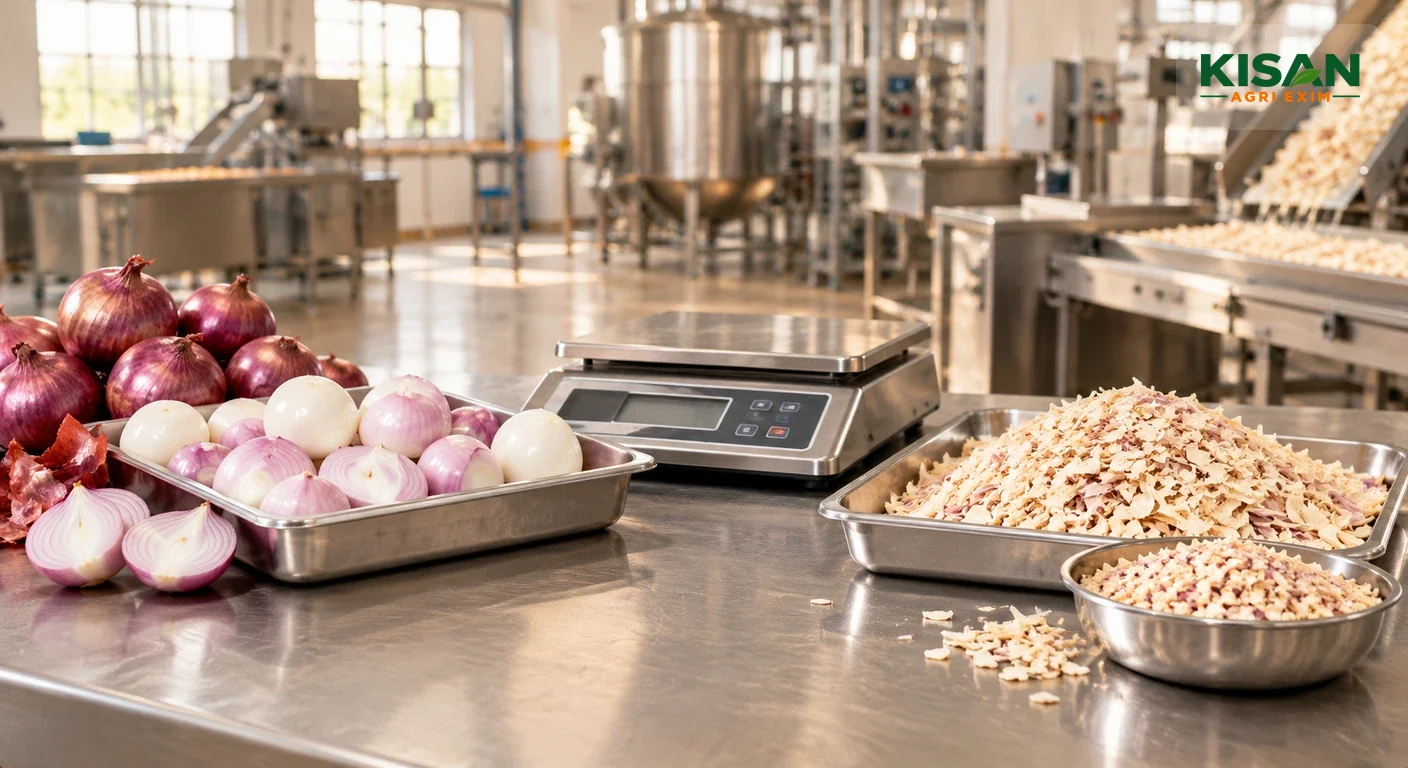
Dehydration provides a way to convert suitable fresh onions into a shelf-stable ingredient with substantially lower water content. Instead of relying entirely on immediate fresh-market consumption, suitable onions can enter a controlled processing chain and become dehydrated flakes, chopped pieces, minced products, granules or powder.
The dehydration process therefore serves two functions: it produces an ingredient for food manufacturers and provides another route for utilizing agricultural production beyond the immediate fresh market.
For industrial buyers, the result is a product that can be transported, stored and incorporated into food formulations without handling fresh onions at the same frequency.
For the agricultural supply chain, processing can create an additional demand channel for suitable onion production and reduce dependence on a single fresh-market outlet.
From Fresh Onion to Finished Dehydrated Product
The farm-to-factory process can be viewed as a series of controlled stages:
1. Agricultural Sourcing
Suitable onions are sourced through the regional procurement network. The raw material is assessed for physical condition and suitability for processing.
2. Raw-Material Reception and Sorting
Fresh onions entering the processing chain are checked and unsuitable material is removed. Sorting establishes a more consistent input for subsequent processing.
3. Preparation
The onions are prepared for dehydration through the required processing stages. Preparation requirements can vary according to the intended finished cut.
4. Controlled Dehydration
Water is removed through controlled drying to produce the required dehydrated form. Moisture control is a key quality parameter for finished dehydrated onion products.
5. Cutting and Screening
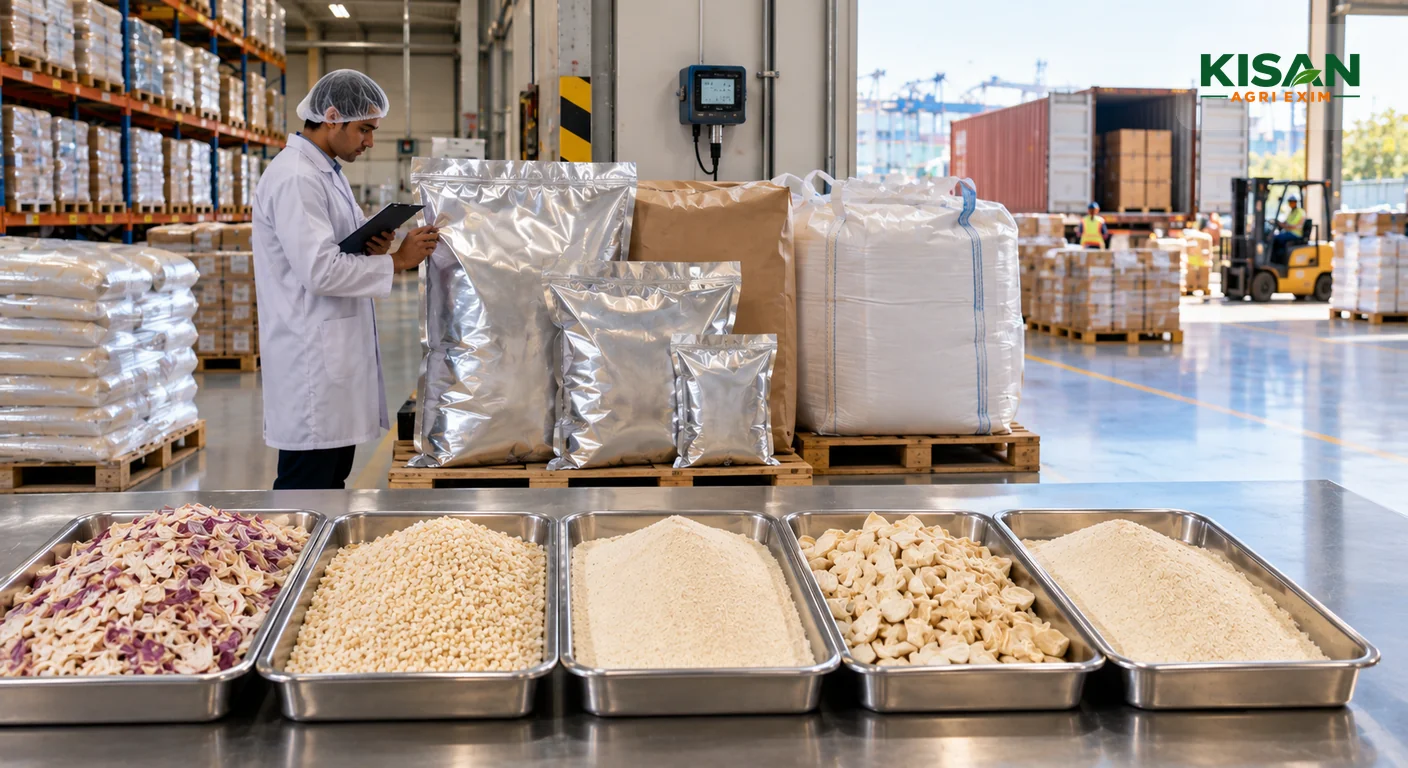
Depending on the required SKU, the dehydrated material can be processed into different particle sizes such as flakes, chopped pieces, minced products, granules or powder.
6. Quality Inspection
Finished material is evaluated against agreed product specifications, including parameters such as moisture, appearance and particle size where applicable.
7. Packaging and Export Preparation
The finished product is packed according to the agreed packaging specification and prepared for shipment to the buyer’s destination market.
How Dehydration Creates More Supply-Chain Stability
Fresh agricultural markets can experience significant variation because production and demand are seasonal. Dehydrated products operate differently because processing converts fresh produce into an ingredient that can be stored and transported for industrial use.
This does not eliminate agricultural price or supply fluctuations, but it provides another channel through which suitable crop production can enter the food-ingredient market.
For farmers, a stronger processing ecosystem can contribute to a more diversified demand base. For processors, established agricultural relationships can support raw-material planning. For food manufacturers, the result is access to a standardized ingredient that can be purchased according to production requirements.
The long-term value comes from connecting these three parts of the chain rather than treating farming, processing and export as separate activities.
Building Long-Term Farmer Relationships
A sustainable sourcing network requires more than individual transactions. Consistent communication around crop requirements, quality expectations and procurement timing can help farmers understand what the processing operation requires.
Over time, these relationships can support better coordination between agricultural production and processing demand. Farmers can gain greater visibility into the characteristics required by the food-processing industry, while processors can develop a better understanding of local crop availability and seasonal conditions.
The objective is not simply to increase procurement volume. It is to build a supply network where agricultural quality, processing requirements and commercial demand are connected.
Future Direction: FPOs, Training and Organic Blocks
As the sourcing network develops, structured farmer engagement can create additional opportunities for the agricultural supply chain.
FPO Tie-Ups
Working with Farmer Producer Organizations (FPOs) can provide a more organized connection between groups of farmers and industrial procurement requirements. Such relationships can support coordinated sourcing, quality communication and supply planning.
Farmer Training
Training initiatives can focus on areas relevant to processing quality, including harvest timing, post-harvest handling, sorting and storage practices. Better handling between harvest and processing can help preserve raw-material quality.
Organic Production Blocks
Developing dedicated organic production blocks is another potential direction for future sourcing. Such programs require appropriate agricultural practices, traceability and certification processes to support genuine organic claims in the finished supply chain.
These initiatives are part of a longer-term approach to developing a more structured connection between farmers, processing operations and international food-ingredient markets.
What This Means for International Buyers
For an international buyer, the farm-to-factory model provides visibility into an important part of the supply chain that is often hidden behind the finished product.
Raw-material sourcing influences the consistency of the processing input. Processing controls influence the finished product. Packaging and logistics influence how that product reaches the buyer.
A supplier that understands these connections can build procurement and production decisions around the requirements of the final application rather than treating each shipment as an isolated transaction.
For dehydrated onion buyers, this origin-to-export connection is particularly relevant when consistent specifications, repeat supply and long-term procurement planning are required.
Conclusion
The journey from farm to factory is a critical part of dehydrated onion production, with raw-material selection, post-harvest handling and processing all contributing to the finished product. Kisan Agri Exim’s connection with the farming ecosystem around Mahuva and Saurashtra provides a foundation for linking local agricultural production with organized dehydration and export supply.
Longer-term initiatives such as FPO partnerships, farmer training and potential organic production blocks can further strengthen this connection between Gujarat’s farmers and international food-ingredient markets.
Next Step
See direct manufacturer cut forms in our dehydrated onion range or dehydrated garlic range, or talk to our export sales desk to get verified crop-season pricing and custom export specifications.
FAQs
Where does Kisan Agri Exim source onions?
Kisan Agri Exim’s sourcing network is connected to agricultural regions around Mahuva and the wider Saurashtra area of Gujarat. Procurement is focused on obtaining suitable raw material for dehydration and export-oriented processing.
What factors matter when selecting onions for dehydration?
Physical condition, maturity, cleanliness, damage levels, processing suitability and consistency of supply are important considerations. The required raw-material characteristics can vary according to the intended dehydrated product.
How does dehydration help reduce post-harvest losses?
Dehydration converts suitable fresh onions into a lower-moisture, shelf-stable ingredient, reducing dependence on immediate fresh-market consumption. This creates an additional processing route for agricultural produce that meets the required quality criteria.
Does Kisan Agri Exim work directly with farmers?
The sourcing model is connected to the local agricultural ecosystem around Mahuva and Saurashtra, with farmer relationships forming part of the raw-material supply chain. The procurement approach focuses on quality, suitability and supply requirements for processing.
What are the future plans for farmer engagement?
Potential areas of development include FPO tie-ups, farmer training and dedicated organic production blocks. These initiatives can help improve coordination between agricultural production, processing requirements and traceable supply.
Ready to source?
Looking for a reliable export partner?
Our export team responds within 24 hours to help you with your bulk sourcing and custom quotation requirements.