

Export Documentation Checklist: Certifications & Documents You Need for Dehydrated Onion & Garlic Imports

Key Takeaway
Your supplier must hold FSSAI certification + APEDA registration. Request 6 documents before booking: COA, Certificate of Origin, phytosanitary certificate, commercial invoice, packing list, and fumigation certificate (if required).
Required supplier certifications
FSSAI (Food Safety and Standards Authority of India)
Mandatory for any Indian manufacturer processing food for domestic or export supply. Confirms the facility meets India’s food safety, hygiene, and labeling regulations.
APEDA (Agricultural and Processed Food Products Export Development Authority)
Required for agricultural exporters from India. Confirms the company is authorized to export processed food products. Buyers can verify any supplier’s APEDA registration on the APEDA website.
KISAN AGRI EXIM holds both FSSAI certification and APEDA registration.
The 6-document checklist
Request and confirm availability of these documents at the quotation stage — not after the order is placed:
| # | Document | Purpose |
|---|---|---|
| 1 | Certificate of Analysis (COA) | Confirms moisture, particle size, microbiology, and color for the specific batch |
| 2 | Certificate of Origin | Required by most import countries for tariff classification |
| 3 | Phytosanitary Certificate | Plant health certificate issued by India’s Directorate of Plant Protection |
| 4 | Commercial Invoice | Itemized invoice with quantities, unit price, total value |
| 5 | Packing List | Bag count, net/gross weights, pallet configuration |
| 6 | Fumigation Certificate | Required by some destinations (check your country’s import requirements) |
Packaging and shelf life
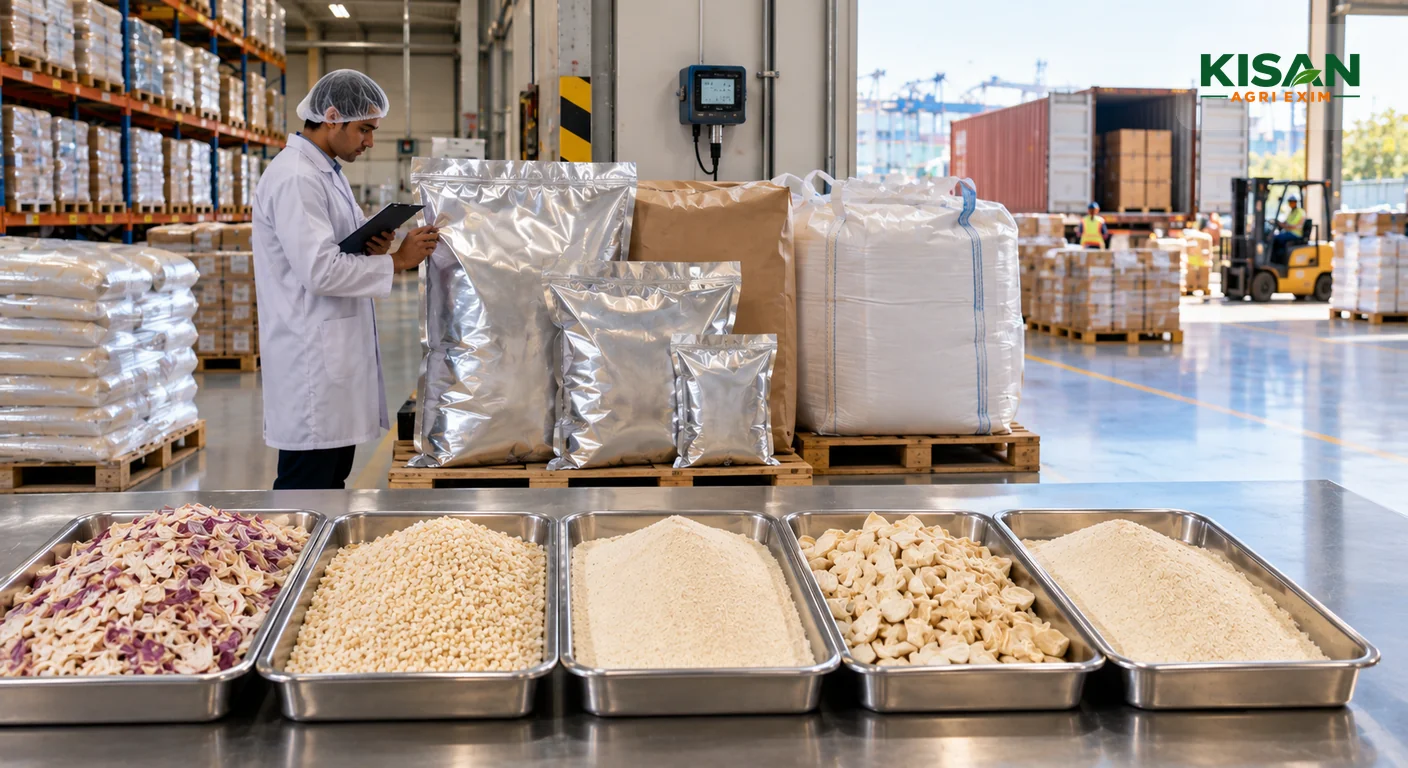
- Standard packaging: 25 kg multi-layer moisture-barrier bags
- Custom options: Private-label, retail-size, or buyer-specified packaging
- Shelf life: 12–24 months (format-dependent), stored in cool, dry conditions in original sealed packaging
Conclusion
Verifying supplier certifications and collecting all six export documents at the quotation stage — not after the order is placed — is the single most effective way to prevent customs delays, port rejections, and compliance failures. Treat FSSAI and APEDA registration as non-negotiable baselines, and request the COA, Certificate of Origin, phytosanitary certificate, commercial invoice, packing list, and fumigation certificate as a standard package before committing to any bulk order.
Next Step
Compare certified export grades across our dehydrated onion and dehydrated garlic product ranges or talk to our export sales desk to receive full specification sheets, COA copies, and a custom bulk quote for your market.
FAQs
Is FSSAI certification mandatory for exporting food products from India?
Yes, FSSAI certification is mandatory for any Indian food processor or exporter. It ensures the facility meets India’s national food safety, hygiene, and sanitary regulations.
How can a buyer verify a supplier’s APEDA registration?
Buyers can verify any Indian agricultural exporter’s registration details directly on the official APEDA website using the exporter’s registered company name or certificate number.
What export documents are needed for custom clearance of dehydrated vegetables?
The core documents required include the Certificate of Analysis (COA), Certificate of Origin, Phytosanitary Certificate, Commercial Invoice, Packing List, and a Fumigation Certificate where applicable.
Ready to source?
Looking for a reliable export partner?
Our export team responds within 24 hours to help you with your bulk sourcing and custom quotation requirements.