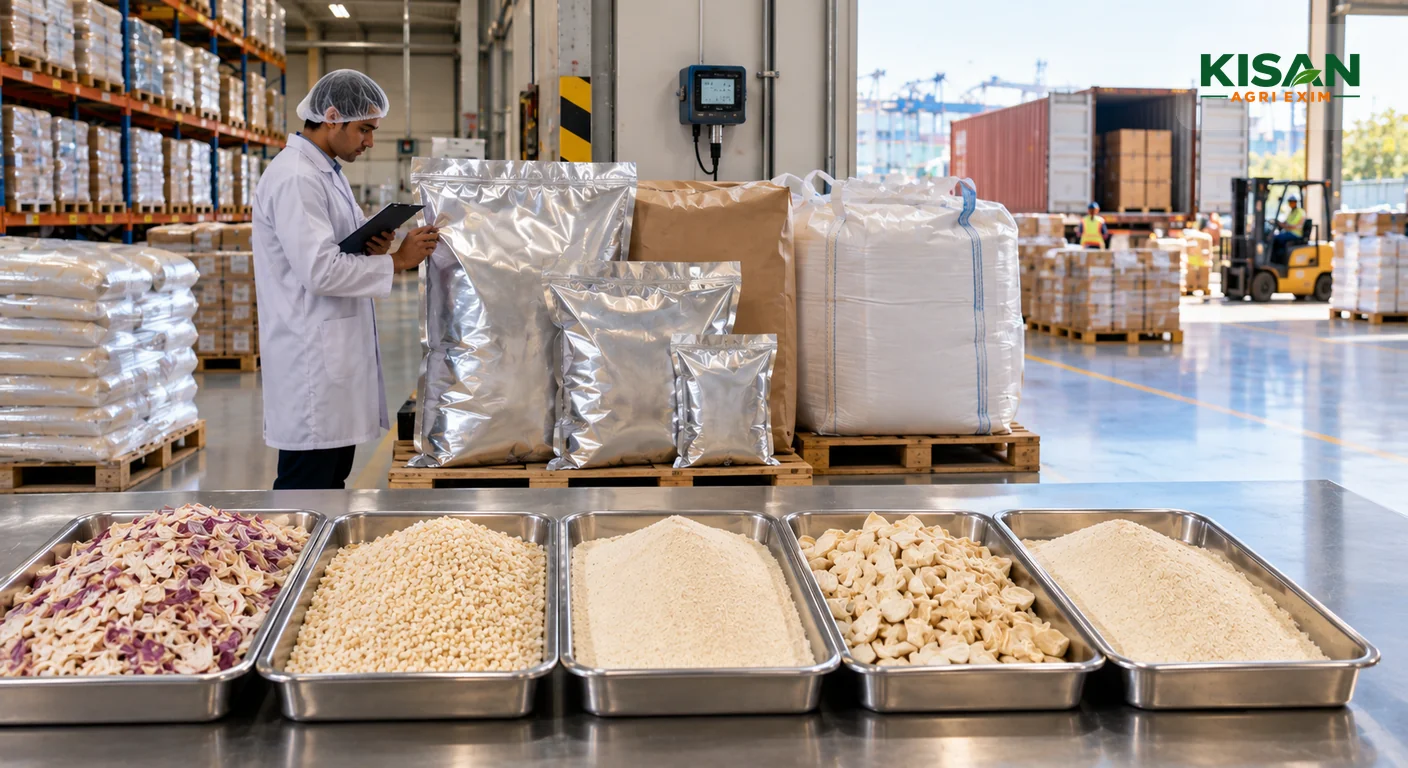


Cost-in-Use: Dehydrated vs Fresh
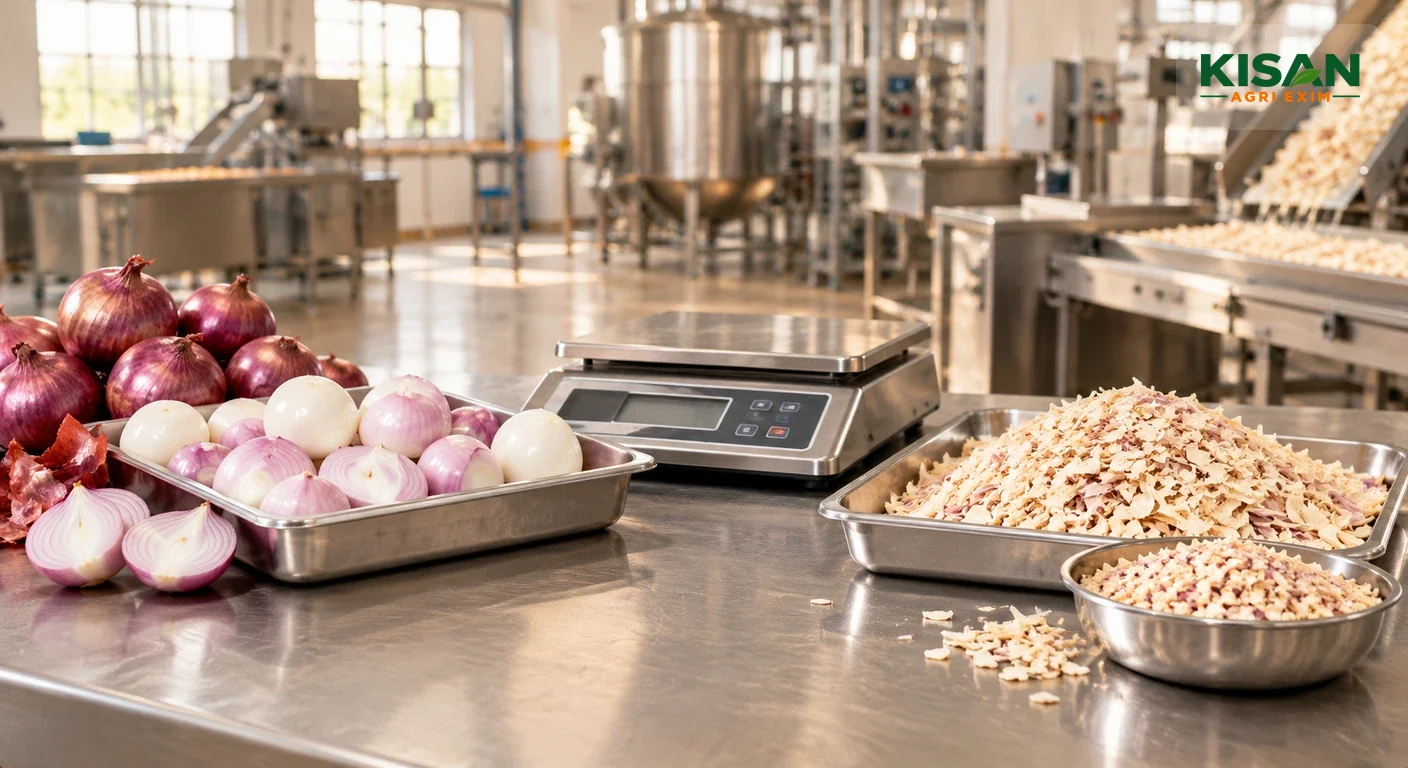
Key Takeaway
Cost-in-use compares the usable ingredient cost in a finished recipe rather than the supplier price per kg. For dehydrated onion and garlic, the calculation should include conversion yield, trim waste, labor, storage, freight, processing energy, and expected losses.
What Is Cost-in-Use?
Cost-in-Use (CIU) measures what an ingredient actually costs a manufacturer after accounting for the quantity required, preparation losses, handling, storage, freight, processing, and other costs needed to deliver the required usable ingredient into a production batch.
For procurement teams, this is more useful than comparing supplier prices alone. A fresh onion may have a much lower price per kilogram than dehydrated onion, but the comparison changes after peeling, trimming, moisture removal, labor, storage, spoilage, and processing requirements are included.
For R&D teams, the relevant question is therefore not simply “What is the price per kg?” but “What does this ingredient cost to deliver the required functional quantity in the finished recipe?”
Core Cost-in-Use Model:
Cost-in-Use = Total Cost Required to Deliver Usable Ingredient ÷ Usable Ingredient Quantity
For a production comparison, total cost can include:
- Raw ingredient purchase price
- Trim and preparation losses
- Processing or drying cost
- Labor and sanitation
- Storage
- Freight and handling
- Spoilage or write-offs
- Additional process energy
- Packaging or handling costs where material
The exact model should match the manufacturer’s own cost-accounting system. Not every factory will assign every overhead to the ingredient level.
Fresh-to-Dehydrated Conversion Ratios
The first step is to establish how much dehydrated onion or garlic is required to replace the usable fresh ingredient in the recipe.
Dehydration removes most of the water while retaining the ingredient’s solids. As a result, a relatively small quantity of dehydrated allium can represent several kilograms of fresh material.
Typical working ranges are:
| Ingredient | Dehydrated Format | Working Fresh-to-Dehydrated Ratio | Approximate Equivalent |
|---|---|---|---|
| Onion | Flakes / Kibbled / Powder | 8:1–10:1 | 1 kg dehydrated ≈ 8–10 kg fresh cleaned onion |
| Garlic | Minced / Granules / Powder | 4:1–5:1 | 1 kg dehydrated ≈ 4–5 kg fresh peeled garlic |
These are working formulation ranges, not fixed conversion standards. Actual replacement should be established from the supplier specification and the manufacturer’s recipe trials.
The ratio can change because of:
- Fresh raw material moisture
- Variety and growing conditions
- Fresh trimming and peeling losses
- Final dehydrated moisture
- Cut size
- Bulk density
- Desired flavor intensity
- Whether the product is rehydrated or used as a dry ingredient
For commercial costing, R&D should therefore validate the ratio using the actual specification being purchased rather than applying a generic conversion factor to every supplier.
Why Moisture Matters
Fresh onion typically contains a high proportion of water, while dehydrated onion contains substantially less. The same principle applies to garlic, although its initial moisture content is generally lower than onion.
This means that comparing $0.80/kg fresh onion directly with $6.50/kg dehydrated onion is misleading.
The correct comparison is the cost of obtaining the same usable quantity or recipe-equivalent contribution.
The Cost Factors Procurement Should Include
A useful CIU comparison normally starts with five major cost areas.
1. Purchase Price and Usable Yield
Fresh ingredients rarely provide 100% usable material.
Onions may require:
- Peeling
- Topping and tailing
- Removal of damaged tissue
- Sorting
- Washing
- Cutting
Garlic may require:
- Skin removal
- Root trimming
- Sorting
- Removal of damaged cloves
- Preparation before processing
If 20% of purchased fresh onion is lost during preparation, purchasing 100 kg does not provide 100 kg of usable onion.
Required Purchase Quantity = Required Usable Quantity ÷ (1 − Loss Rate)
For example:
- 100 kg usable onion ÷ (1 − 0.20) = 125 kg fresh onion required
That additional 25 kg is a real ingredient cost even though it never enters the recipe.
Dehydrated ingredients are supplied in a ready-to-use format, so the factory generally has much less preparation and trim loss. However, buyers should not automatically assume a literal 100% usable yield. Dust, damaged material, foreign-material removal, handling losses, and specification rejects can still occur.
2. Labor and Preparation
The purchase price also excludes the labor required to convert a fresh ingredient into a production-ready ingredient.
Depending on the factory setup, fresh onion or garlic preparation can involve:
- Receiving and sorting
- Washing
- Peeling
- Cutting
- Equipment operation
- Sanitation
- Line changeover
- Cleaning and waste handling
Dehydrated onion and garlic can normally be added directly according to the recipe specification, reducing preparation steps.
The correct comparison is therefore not simply:
Fresh ingredient price vs. Dehydrated ingredient price
but rather:
(Fresh ingredient + preparation cost) vs. (Dehydrated ingredient + handling cost)
3. Storage and Spoilage
Storage conditions can materially affect CIU.
Fresh alliums have a substantially shorter practical storage window than properly packed dehydrated products and may require controlled storage depending on the product, facility, and local conditions.
Dehydrated onion and garlic are shelf-stable ingredients when properly dried, packed, and stored according to the supplier’s specification.
For costing, procurement should consider:
- Storage space
- Temperature requirements
- Inventory holding time
- Product deterioration
- Spoilage
- Stock rotation
- Write-offs
- Packaging integrity
Do not treat a nominal shelf-life figure as a guaranteed usable period under every warehouse condition. The supplier’s specification and packaging/storage instructions should determine the commercial assumption.
4. Freight and Handling
Water is a major part of the weight of fresh produce.
When a manufacturer buys fresh onion and then removes water internally, the manufacturer is effectively transporting and handling that water before processing.
Dehydrated products move much less water through the supply chain.
For a meaningful comparison, calculate:
Freight Cost per Usable kg = Total Freight Cost ÷ Usable Ingredient Quantity
For imported dehydrated products, the comparison should include the actual landed cost where relevant:
- Product price
- Ocean or road freight
- Insurance
- Duties and taxes
- Port and documentation charges
- Inland transport
- Handling
A domestic fresh-versus-imported dehydrated comparison should therefore use landed cost, not just the supplier’s quoted FOB or EXW price.
5. Processing Energy and Production Yield
The final cost factor is what happens after the ingredient reaches the production line.
When fresh onion or garlic is added to a process, its high water content may affect:
- Kettle heating time
- Evaporation load
- Cooking time
- Final solids
- Batch weight
- Concentration
- Process throughput
Dehydrated ingredients introduce much less water into the formulation.
However, this saving depends on the application. A dry seasoning, snack coating, or powdered soup mix may gain more from a low-moisture ingredient than a wet sauce where water is already intentionally part of the formulation.
This is why CIU should be calculated against the actual production recipe, not only against a theoretical fresh-to-dry conversion.
Cost-in-Use Calculation Example
Consider a manufacturer producing an industrial soup or sauce that requires 100 kg of usable onion for a production batch.
The manufacturer compares fresh onion with dehydrated onion flakes.
Example Inputs
| Cost Parameter | Fresh Onion | Dehydrated Onion |
|---|---|---|
| Supplier price | $0.80/kg unpeeled | $6.50/kg |
| Preparation loss | 20% | Minimal preparation loss |
| Usable quantity required | 100 kg | 100 kg fresh-equivalent |
| Working conversion ratio | — | 1 kg dehydrated = 9 kg fresh cleaned |
| Preparation / labor cost | $0.25/kg usable equivalent | Approx. $1.00 batch allowance |
| Storage / spoilage allowance | $0.10/kg purchased | $0 for this simplified example |
Step 1: Calculate Fresh Onion Requirement
The manufacturer needs 100 kg of usable onion and expects 20% preparation loss:
- Required raw onion quantity: 100 kg ÷ 0.80 = 125 kg
Therefore, the factory must purchase approximately 125 kg of fresh onion.
- Raw material cost: 125 kg × $0.80 = $100.00
Step 2: Calculate Dehydrated Onion Requirement
Using a working conversion ratio of 1 kg dehydrated onion = 9 kg fresh cleaned onion:
-
Required dehydrated quantity: 100 kg ÷ 9 = 11.11 kg
-
Raw material cost: 11.11 kg × $6.50 = $72.22
Step 3: Add Operating Costs
| Cost Factor | Fresh Onion | Dehydrated Onion |
|---|---|---|
| Gross material required | 125 kg | 11.11 kg |
| Raw material cost | $100.00 | $72.22 |
| Preparation / handling | $25.00 | $1.00 |
| Storage / spoilage allowance | $12.50 | $0.00 |
| Illustrative total | $137.50 | $73.22 |
| Cost per kg usable equivalent | $1.38/kg | $0.73/kg |
Under these assumptions:
- Savings per batch: $137.50 − $73.22 = $64.28
- Cost reduction: ($64.28 ÷ $137.50) × 100 = 46.7%
The important point is not the specific 46.7% result. It is the calculation method.
If the fresh onion price, dehydration price, labor rate, conversion ratio, storage cost, or process requirements change, the result changes with them.
What This Example Does Not Include
This simplified example excludes several factors that may be important in a real factory:
- Freight differential
- Energy consumption
- Water used during preparation
- Waste disposal
- Equipment depreciation
- Production downtime
- Recipe reformulation
- Import duties
- Packaging differences
- Financing and inventory carrying cost
A procurement team should add these when they are material to the decision.
Build a Like-for-Like CIU Model
The biggest mistake in ingredient comparisons is comparing two products that do not perform the same job in the recipe.
A better procurement worksheet should contain:
| Variable | Fresh Ingredient | Dehydrated Ingredient |
|---|---|---|
| Supplier price/kg | Actual quote | Actual quote |
| Purchase basis | Unpeeled / whole | Finished specification |
| Moisture | Supplier specification | Supplier specification |
| Trim / preparation loss | Trial or historical data | Actual handling loss |
| Usable yield | Calculated | Calculated |
| Required recipe quantity | Recipe basis | Recipe-equivalent basis |
| Labor | Actual plant cost | Actual plant cost |
| Storage | Actual cost | Actual cost |
| Freight | Actual landed cost | Actual landed cost |
| Process energy | Measured/estimated | Measured/estimated |
| Waste / spoilage | Historical rate | Historical rate |
| Final CIU | Calculated | Calculated |
This creates a much more defensible comparison than using the quoted purchase price alone.
How Consistent Specifications Reduce Cost Variation
Cost-in-use is not only about the average price. Specification consistency affects the reliability of that cost.
Two suppliers can quote the same price per kilogram while producing different economic results if their material behaves differently in production.
Moisture Consistency
Moisture directly affects the amount of dry material being purchased.
If a dehydrated ingredient has inconsistent moisture, the effective amount of dry solids delivered per kilogram can change.
For this reason, buyers should define an agreed moisture specification rather than treating “dehydrated” as a sufficient quality description.
Kisan Agri Exim’s standard product framework uses moisture specifications around ≤ 6% for many dehydrated cut forms, with the exact specification depending on product and grade.
Mesh and Particle Size
Particle size affects:
- Dispersion
- Hydration
- Mixing
- Bulk density
- Packaging
- Final product appearance
- Flavor distribution
For example, flakes, minced material, granules, and powder should not be treated as interchangeable simply because they originate from the same onion or garlic.
A manufacturer should specify the required cut or mesh before comparing supplier prices.
Color and Appearance
In products where onion or garlic remains visible, color variation can affect finished-product appearance and may lead to sorting or rejection.
A supplier specification should define acceptable visual characteristics rather than relying only on a general product name.
Flavor and Functional Consistency
Natural alliums vary with variety, growing conditions, maturity, storage, and processing.
For R&D teams, this can translate into changes in:
- Flavor intensity
- Pungency
- Aroma
- Color contribution
- Rehydration behavior
A consistent specification and representative pre-production sample help reduce the risk of reformulating a recipe after commercial production begins.
Cost-in-Use for Dry and Wet Applications
The same ingredient can produce different CIU results depending on its application.
Dry Applications
Examples include:
- Snack seasonings
- Spice blends
- Dry soup mixes
- Instant noodles
- Coatings
- Bakery mixes
For these products, dehydrated onion and garlic can avoid introducing the high water load associated with fresh material.
The ingredient can often be dosed directly into the dry mix according to the required particle size and flavor specification.
Wet Applications
Examples include:
- Sauces
- Gravies
- Soups
- Ready meals
- Cooking pastes
Dehydrated alliums can be incorporated into the formulation’s water phase and allowed to rehydrate.
However, R&D should validate:
- Hydration time
- Water requirement
- Final texture
- Flavor release
- Particle appearance
- Mixing behavior
The objective is not simply to replace a certain weight of fresh onion or garlic. The objective is to achieve the required finished-product performance at the lowest reliable total cost.
A Practical Procurement Formula
For supplier comparisons, start with the following model:
CIU per Usable kg = (Purchase Cost + Freight + Labor + Storage + Processing + Waste + Other Material Costs) ÷ Usable Quantity
Then calculate the recipe-level cost:
Recipe Ingredient Cost = CIU × Required Usable Quantity
For dehydrated ingredients, also validate the fresh-equivalent conversion through an R&D trial.
This gives Procurement and R&D a shared basis for evaluating suppliers.
What Procurement Should Request From Suppliers
Before approving a dehydrated onion or garlic supplier, request:
- Product format and cut size
- Moisture specification
- Mesh or particle-size specification
- Color requirements
- Microbiological specification
- Foreign-material controls
- Packaging format
- Shelf-life specification
- Storage requirements
- Country and region of origin
- COA availability
- Batch traceability
- Available treatment or microbiological reduction options
- Commercial terms and minimum order quantity
These specifications allow the buyer to compare suppliers on usable production value, rather than simply quoted price per kilogram.
Conclusion
Cost-in-use provides a more realistic way to compare fresh and dehydrated onion or garlic because it accounts for the costs required to turn a purchased ingredient into usable production material. Purchase price, yield loss, labor, storage, freight, processing requirements, and specification consistency can all materially change the final economics.
For procurement and R&D teams, the most reliable approach is to establish a recipe-specific conversion ratio, use actual plant costs, and validate the dehydrated ingredient through production trials before making a long-term cost assumption.
Next Step
Explore our dehydrated onion range or dehydrated garlic range, or contact our export sales desk to request product specifications, samples, or a custom bulk quote for your market.
FAQs
How do you calculate cost-in-use for dehydrated onion?
Calculate the total cost of the quantity of dehydrated onion required to achieve the recipe’s target fresh-equivalent quantity, then add relevant freight, handling, storage, and processing costs. The comparison should use the same usable output basis as the fresh ingredient.
What is the typical fresh-to-dehydrated onion ratio?
A practical working range is approximately 8:1 to 10:1 for fresh cleaned onion to dehydrated onion, depending on raw material moisture, final moisture, and product format. R&D should validate the actual ratio against the supplier’s specification and production trial.
Is dehydrated onion cheaper than fresh onion?
The purchase price per kilogram is usually higher for dehydrated onion, but the total cost can be lower after accounting for fresh preparation losses, labor, storage, spoilage, freight, and processing requirements. The result must be calculated using the manufacturer’s actual costs.
How does moisture affect ingredient cost-in-use?
Higher moisture means a greater proportion of each kilogram is water rather than dry ingredient solids. For meaningful supplier comparisons, buyers should compare products against an agreed moisture specification and recipe performance rather than price per kilogram alone.
What information should I request when comparing dehydrated onion suppliers?
Request the product cut or mesh, moisture specification, microbiological limits, appearance requirements, packaging, shelf life, storage conditions, traceability, COA availability, and commercial terms. These specifications allow Procurement and R&D to compare usable production value rather than only the quoted price.
Ready to source?
Looking for a reliable export partner?
Our export team responds within 24 hours to help you with your bulk sourcing and custom quotation requirements.